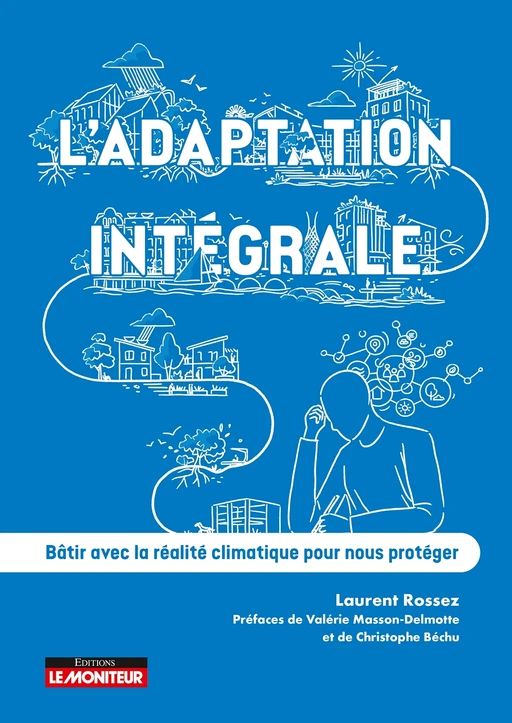
This publication reflects our ability to keep pushing the debate further in order to drive concrete action, both within our teams and alongside our partners.
Climate change is now generating systemic crises that affect our most sensitive assets: hospitals, public buildings, multimodal transport hubs, and civil protection and energy infrastructure.
In her opening remarks, Delphine Beji recalled the foundations of this approach:
“The architecture professions are evolving to adapt as well. It is no longer simply a matter of building according to the climate, but of designing to protect in a world of climate instability. This approach, which we call Integral Adaptation, transforms climate instability into a fundamental input for architectural design.”
Our thanks to Christophe Béchu for his committed message:
“Adapting our country is a fundamental responsibility. I would even say it is a sovereign responsibility in the noblest sense of the term, because it is fundamentally about protecting our citizens and our territories.”
Our thanks also to the panel speakers for the richness of their analyses and discussions:
- Sakina Pen Point, Adaptation Project Director at Cerema:
“Risks are territorial. A highly efficient, technology-filled building is of little value if networks no longer function and resources can no longer be delivered.” - Romain Gorges, Climate Expert at the French State Property Directorate (DIE):
“While mitigation is more of an engineering challenge, adaptation is above all a societal challenge, because we will have to decide collectively what matters most in order to target our investments.” - Julie Nicolas, Editor-in-Chief of Les Cahiers Techniques du Bâtiment:
“The National Climate Change Adaptation Plan (PNACC) remains little more than wishful thinking, while people are already suffering in cities and housing that are no longer adapted. It is urgent to translate these guidelines into action and to disseminate them widely in order to support implementation.” - Magali VIDAL BEDOK, Urban Planner at the Haut-Anjou Community of Municipalities and Head of the Petites Villes de Demain programme:
“Part of the adaptive solutions lies in bringing together stakeholders across local territories. What matters is creating projects that inspire people and bring them on board, giving them the desire to see them through to completion.” - Cécile Gruber, Director of Transitions at the Paris Climate Agency:
“This book, which conveys a perspective that is rarely heard, is a sign of hope that stakeholders in the construction sector will fully embrace this issue.”
Our conviction : in the face of climate challenges, adaptation must become a founding principle for the design, rehabilitation and transformation of our territories.ciple guiding the design, rehabilitation and transformation of our cities and territories.